By Norman Ford · Updated October 2026 · How we check specs
18 wheeler truck tire position chart (printable)
Key point: there is no federal standard for numbering truck tire positions, so the best chart is one your drivers, shop and tire vendor all use the same way. The chart below gives every position on a standard five-axle tractor-trailer both an axle code and a sequential number, so you can use whichever your records already follow.
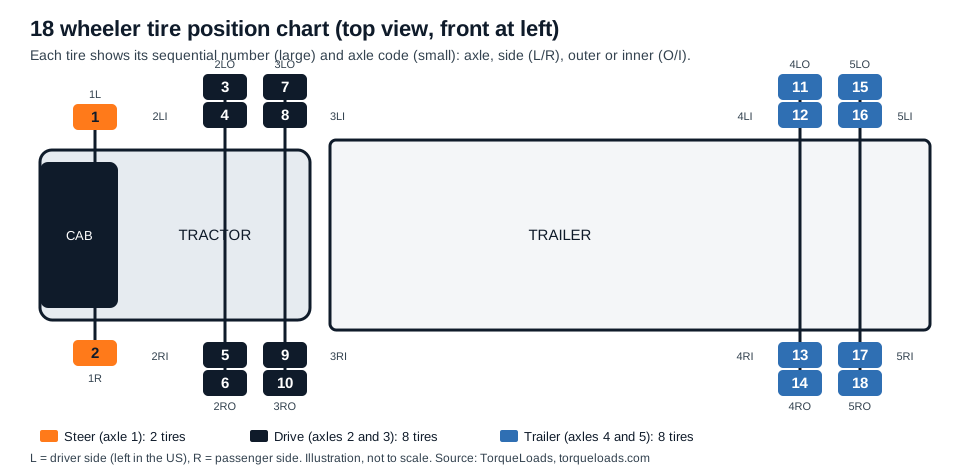
Open the chart as a printable image
The 18 positions in a table
| No. | Axle code | Axle | Side | Inner or outer | Position type |
|---|---|---|---|---|---|
| 1 | 1L | 1 | Left | Single | Steer |
| 2 | 1R | 1 | Right | Single | Steer |
| 3 | 2LO | 2 | Left | Outer | Drive |
| 4 | 2LI | 2 | Left | Inner | Drive |
| 5 | 2RI | 2 | Right | Inner | Drive |
| 6 | 2RO | 2 | Right | Outer | Drive |
| 7 | 3LO | 3 | Left | Outer | Drive |
| 8 | 3LI | 3 | Left | Inner | Drive |
| 9 | 3RI | 3 | Right | Inner | Drive |
| 10 | 3RO | 3 | Right | Outer | Drive |
| 11 | 4LO | 4 | Left | Outer | Trailer |
| 12 | 4LI | 4 | Left | Inner | Trailer |
| 13 | 4RI | 4 | Right | Inner | Trailer |
| 14 | 4RO | 4 | Right | Outer | Trailer |
| 15 | 5LO | 5 | Left | Outer | Trailer |
| 16 | 5LI | 5 | Left | Inner | Trailer |
| 17 | 5RI | 5 | Right | Inner | Trailer |
| 18 | 5RO | 5 | Right | Outer | Trailer |
Cite or embed this
How to read the 18 wheeler semi truck tire position diagram
The chart is a top view with the front of the truck at the left. Read it like this:
- Axles are numbered front to back. Axle 1 is the steer axle, axles 2 and 3 are the tractor's drive axles, and axles 4 and 5 are the trailer axles.
- Left and right are from the driver's seat. In the US, left (L) is the driver side and right (R) is the passenger side. On the diagram, the left side of the truck is at the top.
- Outer (O) and inner (I) apply to dual wheels. The outer tire is the one you see from the side; the inner tire sits between it and the frame.
- The sequential number runs 1 to 18, axle by axle from the front, and on each axle from left outer across to right outer.
So tire 8 is 3LI: axle 3, left side, inner dual, a drive tire.
Two common numbering schemes
Axle codes such as 2LO are the easiest for people to read, because the code says where the tire is. They also work for any truck, whether it has 6 tires or 22.
Sequential numbers are compact and work well in spreadsheets and some tire software. The catch is that the order must be agreed. Some fleets count left to right, some count around the truck clockwise, and some count outer tires before inner tires. If your software or tire vendor uses a different order, use theirs and write it on your chart.
Whatever scheme you choose, write it on the inspection form and the tire record so a new driver or a new shop reads it the same way.
Steer, drive and trailer positions
Each position type has its own rules and wear habits:
- Steer (1 and 2): the legal minimum tread depth is 4/32 inch under 49 CFR 393.75(b). Steer tires wear first on the shoulders when alignment is off.
- Drive (3 to 10): the legal minimum is 2/32 inch. Drive tires carry engine torque and often show heel and toe wear.
- Trailer (11 to 18): the legal minimum is 2/32 inch. Trailer tires scrub on tight turns and get flat spots from locked brakes.
Source: 49 CFR 393.75, checked October 2026
Using the chart on inspection reports
Driver vehicle inspection reports under 49 CFR 396.11 must list any defect the driver finds that would affect safe operation, including tires. Writing the position code next to the defect saves time:
- "3RO: sidewall cut, cord showing" is clear.
- "Right side drive tire cut" leaves the shop guessing between four tires.
When a roadside inspector writes a tire violation, note the position on your copy too, so the repair order, the tire record and the inspection line up.
Using the chart for tire records and rotation
A tire record by position lets you see patterns no single inspection shows. Record for each position:
- Tread depth at each check, in 32nds of an inch.
- Pressure readings.
- The tire's brand, size and serial number from the sidewall.
- Repairs and the date of each.
- Moves to other positions.
Over a few months, you may find one position always wears fast, which points to alignment, a suspension part or a brake on that wheel end. Our truck tire rotation pattern guide shows how tires move between positions, and our truck tire repair guide covers which damage can be repaired.
Checking every position on a walk-around
A position chart is only useful if every tire actually gets checked. A simple walk-around order that matches the chart:
- Start at the left steer tire (1) and work back along the left side: 3 and 4, 7 and 8, then the trailer tires 11 and 12, 15 and 16.
- Cross behind the trailer and come forward along the right side: 18 and 17, 14 and 13, 10 and 9, 6 and 5, and finally the right steer tire (2).
- At each tire, look at the tread, the sidewalls and the valve stem, and thump or gauge the pressure.
- For duals, check the inner tire too. Look for objects stuck between the duals and for one tire that looks lower than its partner.
Following the same order every time makes it hard to skip a tire, and it matches the order of the numbers on the chart.
Common problems by position
Some problems show up at certain positions more than others:
- Steer tires (1 and 2): shoulder wear from alignment, cupping from balance or worn shocks.
- Inner drive duals (4, 5, 8, 9): low pressure that goes unnoticed, stones between the duals.
- Outer drive duals (3, 6, 7, 10): curb damage on the right side in city work.
- Trailer tires (11 to 18): flat spots from locked brakes, scuffing from tight turns, damage from docks.
Charts for other setups
The same scheme works for any truck:
- Two-axle box truck: 1L, 1R, 2LO, 2LI, 2RI, 2RO. Six tires.
- Tandem tractor alone: positions 1 to 10 from the chart above.
- Wide-base singles: each dual pair becomes one tire, such as 2L and 2R, so an 18 wheeler on wide singles has 10 positions.
- Tri-axle trailers: add axle 6 with four more positions.
- Doubles: number axles through the first trailer, the dolly and the second trailer in order.
Chain positions in winter
Chain laws often say which tires must be chained, such as the outside tires of the drive axles. A position chart makes it easy to tell drivers exactly which tires take chains on your setup. Our truck tire chains guide covers chain laws, and our winter truck tires guide covers tread choices for the cold months.
Tire cost by position
Steer tires usually cost more and are replaced at a higher tread depth, so they cost more per mile than drive or trailer tires. Tracking cost by position shows where the money goes. The tire cost per mile calculator works out the cost for any tire from its price and mileage.
Methodology and updates
The position scheme on this page follows the axle, side and inner or outer convention widely used by fleets and tire vendors. It is not a federal or industry standard, and we say so because some charts online present one numbering order as the only correct one. The legal tread depths come from 49 CFR 393.75 and the inspection report rule from 49 CFR 396.11, both checked on the eCFR in October 2026. We review this chart once a year, or sooner if the rules it cites change. You are welcome to use the chart and the CSV with a credit link to this page.
Dispatch for 26 ft and up
TorqueLoads is a dispatch service for 26 ft box trucks and larger. We find and negotiate loads, the broker sends the rate confirmation to you, and you decide every load. Learn about our dispatch service, read about box truck dispatch, or apply.