By Norman Ford · Updated October 2026 · How we check specs
Truck tire rotation pattern: steer, drive and trailer tires
Rotating car tires follows a simple pattern on a chart. Rotating truck tires is different. A tractor-trailer has three kinds of position, steer, drive and trailer, and each wears tires in its own way. Steer tires carry the steering load and must meet a stricter legal tread minimum. Drive tires carry torque and wear fastest in the center or on one edge depending on the truck. Trailer tires scrub through turns. A good truck tire rotation pattern uses those differences to get the most life out of every tire.
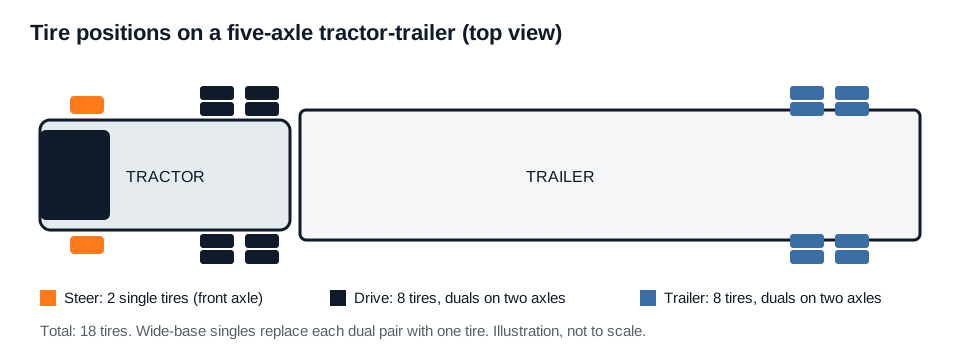
The three positions and how they wear
Tap each position to see how tires wear there and where they usually go next.
Tap a numbered balloon for the part's job, check and spec.
| ITEM | PART | WHAT IT DOES | CHECK |
|---|---|---|---|
| 1 | Steer tires | Two single tires on the front axle that steer the truck and carry the front axle load. | Legal minimum 4/32 inch; shoulder wear, feathering and cupping. |
| 2 | Drive tires | Duals on the driving axles that put engine torque to the road. | Legal minimum 2/32 inch; heel and toe wear, uneven wear between axles. |
| 3 | Trailer tires | Duals or wide singles on the trailer axles that carry the load and follow the tractor. | Legal minimum 2/32 inch; scrubbing on tight turns, flat spots from locked brakes. |
Source: 49 CFR 393.75, checked October 2026
Semi truck tire rotation pattern: the usual moves
Most fleets follow some version of these moves. They are not a federal rule; they are common practice that tire makers and fleets use to spread wear.
Steer tires
Steer tires are usually the most expensive tires on the truck to replace early, and they have the highest legal minimum. Common practice:
- Run them on the steer axle until they reach the pull point your fleet sets, which is above the 4/32 inch legal minimum to leave a safety margin.
- Move them to a drive or trailer position, where the legal minimum is 2/32 inch, and run them out there.
- Swap left and right only when the tire maker allows it and wear suggests it will help. Many steer tires wear one shoulder because of road crown, so a side swap can even it out.
Never put a tire on the steer axle that came off another position worn, damaged or repaired outside what the tire maker allows. Federal rules also bar regrooved tires with a load capacity of 4,920 pounds or more from the front wheels of a truck or truck tractor.
Drive tires
The front and rear drive axles often wear tires at different rates. On many tractors the front drive axle wears faster. Common moves:
- Front to rear on the same side, swapping axles to even out wear.
- Reversing direction of non-directional tires to correct heel and toe wear, the saw-tooth pattern on the tread blocks.
- Matching duals after every move so both tires in a pair have the same diameter and similar tread depth.
Directional drive tires have an arrow on the sidewall. They must keep rolling in that direction, which limits which positions they can move to.
Trailer tires
Trailer tires wear more slowly than drive tires on most work, but they suffer from scrubbing on tight turns and from flat spots when brakes lock. Rotating trailer tires is less common. When it is done, it usually means moving tires between axles on the same side, or flipping a tire on its wheel to reverse its direction if the tread pattern allows.
How to rotate truck tires step by step
Rotation is easiest to do well when it is planned, not done at the side of the road.
- Measure every tire. Use a tread depth gauge in the major grooves at several points around each tire. Write it down by position.
- Look for uneven wear. Feathering, cupping, one-shoulder wear and heel and toe wear each point to a cause. Our semi truck tire wear patterns guide shows each one.
- Fix the cause first. Rotation hides problems for a while. If alignment, pressure, balance or a worn suspension part caused the wear, fix it or the new position will wear the same way.
- Plan the moves so every tire goes to a position where it will wear evenly and meets the legal minimum there.
- Match duals in diameter and tread depth. Mismatched duals overload the larger tire.
- Mount and torque the wheels to the wheel or vehicle maker's spec, with a calibrated torque wrench, and recheck torque after the first miles as the maker says.
- Set pressures cold for each tire's new load.
- Record the new positions. A position chart makes this simple. Our 18 wheeler tire position chart shows a numbering scheme you can use.
When to rotate truck tires
There is no single mileage that suits every truck. These are better triggers:
- Steer tires reach your pull point.
- The two drive axles show a clear difference in tread depth.
- Heel and toe wear develops on drive tires.
- A dual pair becomes mismatched in tread depth.
- At a scheduled PM service, if your readings show it will help.
Measuring tread at every PM service gives you the numbers to decide. Without measurements, a rotation is a guess.
Best way to rotate truck tires: measure first
The best way to rotate truck tires is to let the measurements lead. Here is an EXAMPLE of how a set of readings turns into a plan.
| Position | Reading | Move |
|---|---|---|
| Steer left | 7 | Stay; check alignment for shoulder wear |
| Steer right | 6 | Pull point reached in this EXAMPLE; move to front drive |
| Front drive, left outer | 9 | Swap with rear drive left outer |
| Rear drive, left outer | 14 | Swap with front drive left outer |
| Trailer axle 1, right inner | 10 | Stay |
| Trailer axle 2, right inner | 10 | Stay |
The 6/32 inch pull point in this EXAMPLE is a fleet choice, not a legal limit. The legal minimums are 4/32 inch on the steer axle and 2/32 inch elsewhere.
Rotating truck tires and duals
Duals need special care. Two tires on the same side of an axle share the load only if they have the same diameter. If one tire is larger, it carries more weight, runs hotter and wears faster, while the smaller tire scrubs. A common rule is to match duals within a small difference in diameter or tread depth; the tire maker's guidance gives the exact tolerance. When rotating, plan the moves so each dual pair ends up matched.
Box truck tire rotation
Single rear axle box trucks of 26 ft and up have a simpler layout: two steer tires and four duals on the rear. The same ideas apply. Run the steer tires to your pull point, then move them to the rear if they suit the position. Swap rear duals between inner and outer, or side to side, to even out wear, and keep each pair matched. City work wears steer tires quickly on box trucks, so check them often.
Reading heel and toe wear
Heel and toe wear is the most common reason fleets rotate drive tires. Each tread block wears unevenly, with one edge lower than the other, so the tread looks like a saw blade when you look along it from the side. Run your hand over the tread in both directions: it feels smooth one way and rough the other. It comes from the way drive tires grip and release the road under torque, and it is made worse by low pressure, light loads and lots of highway miles.
Left alone, heel and toe wear gets noisier and spreads, and it shortens the tire's life. Reversing the direction of rotation, by moving the tire to the other side of the truck or turning it on the wheel when the tread is not directional, makes the high edges wear down. Moving it between the front and rear drive axles also helps, because the two axles load the tires differently.
Wide-base singles and rotation
Some trucks and trailers run one wide-base single tire in place of each dual pair. Rotation with wide singles is simpler in one way, because there is no dual matching, and harder in another, because there is no inner tire to share the load if pressure drops. Moves between axles and sides follow the same logic: measure, find the cause of uneven wear, then move the tire to where it will wear evenly. Check the tire maker's guidance for wide singles, since some patterns are designed for one position only.
Common rotation mistakes
- Rotating without measuring. A move made by habit can put a worn tire in the wrong place.
- Moving a tire to the steer axle that does not meet the steer rules or the tire maker's guidance for that position.
- Mismatching duals. A new tire paired with a worn one overloads the new tire.
- Ignoring directional arrows on directional drive tires.
- Skipping the torque check after the wheels go back on.
- Losing track of positions. Without records you cannot see which position eats tires.
What rotation cannot fix
Rotation evens out wear between positions. It does not fix:
- Alignment problems, which wear tires in any position. Our semi truck wheel alignment guide covers the angles.
- Wrong pressure, which wears shoulders when low and the center when high.
- Balance problems, which cause cupping and vibration.
- Worn suspension parts, such as shocks and bushings.
- Damage, such as cuts, bulges or exposed cords, which means the tire comes off, not that it moves. Our truck tire repair guide covers what can and cannot be repaired.
Chains, winter tires and rotation
If you run chains in winter, the tires that take chains, usually drive tires, see extra wear and possible damage. Check those tires closely when the chains come off and before you plan a rotation. Our truck tire chains guide covers chain laws and fitting.
Tire rotation and cost per mile
Rotation pays off when it adds miles to tires you already own. The tire cost per mile calculator shows how much each extra thousand miles is worth for your tire prices and mileage. EXAMPLE: a set of drive tires that costs $4,000 and lasts 250,000 miles costs 1.6 cents a mile. If rotation and matching add 25,000 miles, the cost falls to about 1.45 cents a mile. Those 25,000 extra miles are worth about $400 at the old rate of 1.6 cents a mile. The numbers are an EXAMPLE, but the math is the same for your own prices.
Keeping records by position
Rotation only works if you know where each tire has been. Record for every tire:
- Its position, using a consistent numbering scheme.
- Its tread depth at each check.
- The date and mileage of each move.
- Any repairs.
- The brand, size and casing information from the sidewall.
Over time these records show which positions wear fastest on your truck, which tires last longest and whether alignment or pressure problems are coming back.
Tire rotation and the rest of the PM
Pair a rotation with:
- A wheel end check: hub oil level, seals and bearing play.
- A lug nut torque check after mounting.
- A brake check while the wheels are off.
- An alignment check if wear was uneven.
Dispatch for 26 ft and up
TorqueLoads dispatches 26 ft box trucks and larger. We find and negotiate loads that fit your service days, the broker sends the rate confirmation to you, and you decide every load. Learn about our dispatch service, read about box truck dispatch, or apply here.