By Norman Ford · Updated October 2026 · How we check specs
Semi truck tire wear patterns: a chart of causes and fixes
Key point: most uneven wear on truck tires comes from four things: pressure, alignment, balance and worn suspension or steering parts. Each leaves its own mark on the tread, so reading the pattern tells you where to look. The printable chart below shows eight common patterns side by side.
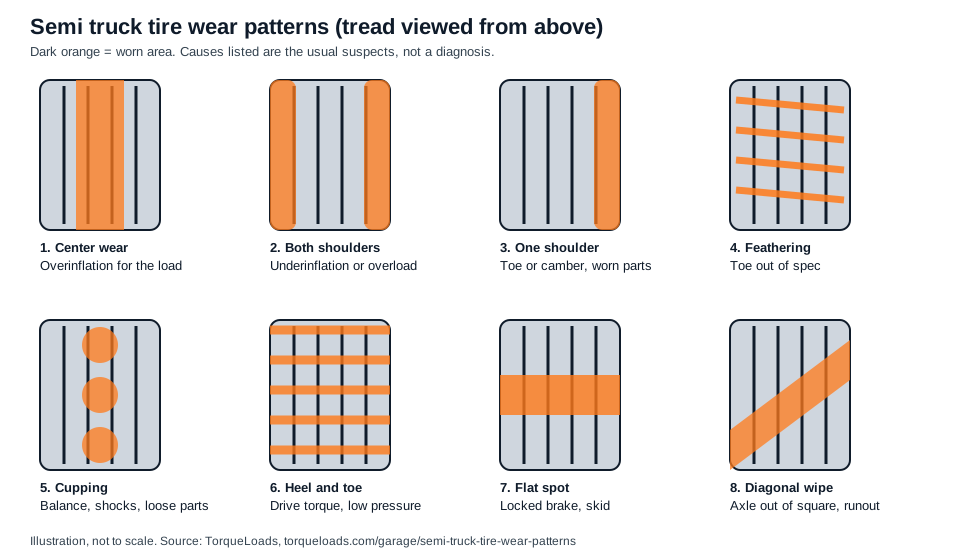
Open the wear pattern chart as a printable image
Wear pattern chart: causes and what to check
| Pattern | What it looks like | Likely causes | What to check |
|---|---|---|---|
| Center wear | Middle ribs worn more than shoulders | Pressure too high for the load | Cold pressure vs the load and inflation table |
| Both shoulders | Outer ribs worn more than the center | Underinflation, overloading | Cold pressure, axle weights, slow leaks |
| One shoulder | Inner or outer rib worn faster | Toe or camber out, worn kingpins or bushings, bent parts | Alignment readings, steering and suspension play |
| Feathering | Ribs sharp one way, smooth the other | Toe out of spec, axle out of square | Toe, drive axle thrust |
| Cupping | Scooped spots around the tread | Imbalance, worn shocks, loose bearings, runout | Balance, shocks, bearing play, wheel runout |
| Heel and toe | Blocks worn like saw teeth | Drive torque, low pressure, light loads, long highway runs | Pressure, rotation direction |
| Flat spot | One worn patch across the tread | Locked wheel, skid, brake problem | Brake adjustment, ABS, dragging brake |
| Diagonal wipe | Worn band running at an angle | Axle out of square, mismatched duals, runout | Trailer and drive axle alignment, dual matching |
Cite or embed this
Semi truck steer tire wear patterns
Steer tires show alignment and steering problems first, because they carry the steering forces and roll free with no torque. Tap each steer pattern to see the cause and fix.
Tap a numbered balloon for the part's job, check and spec.
| ITEM | PART | WHAT IT DOES | CHECK |
|---|---|---|---|
| 1 | Outer or inner shoulder wear | One shoulder wears faster than the other. | Toe, camber, worn kingpin bushings, bent steering arm. |
| 2 | Feathering | Ribs feel sharp in one direction across the tread. | Toe out of spec, or the drive axles pushing the truck sideways. |
| 3 | Cupping | Scooped spots spaced around the tire. | Balance, shocks, wheel bearing play, runout. |
| 4 | River wear | Thin grooves worn along the edges of the ribs. | Often normal on free rolling steer tires; watch that it does not spread. |
Steer tires must keep at least 4/32 inch of tread in a major groove under 49 CFR 393.75(b), and they are the tires drivers rely on most for control. Uneven wear can push a steer tire to that limit long before the rest of the tread is used. When a steer tire wears unevenly, check alignment first; our semi truck wheel alignment guide explains toe, camber and caster.
Semi truck drive tire wear patterns
Drive tires carry engine torque, which changes how they wear.
- Heel and toe wear is the most common. Each tread block wears higher at one edge. It is partly normal for drive tires on long highway runs and gets worse with low pressure and light loads. Reversing the direction of rotation during a rotation evens it out.
- Faster wear on one drive axle usually means the axles are not parallel or one axle carries more weight.
- Center wear on drives often comes from pressure set too high for light loads.
- Irregular wear on duals usually means the two tires in a pair differ in diameter or pressure, so one carries more load.
Keep duals matched and pressures equal within a pair. Our truck tire rotation pattern guide covers moving drive tires to even out wear.
Trailer tire wear patterns
Trailer tires are free rolling, like steer tires, but they are dragged through turns and do not steer. Common trailer patterns:
- Scuffing and tearing on the shoulders from tight turns, especially with spread axles.
- Flat spots from wheels that lock during hard braking or because of a brake or ABS problem.
- Diagonal wipe from trailer axles out of square or dual mismatch.
- One-sided wear on all trailer tires from an axle out of alignment.
Reading wear: how to check a tire properly
- Look across the tread from shoulder to shoulder for differences in depth.
- Measure with a tread depth gauge in at least three grooves, and at several points around the tire.
- Feel the tread by running your hand across it both ways. Feathering and heel and toe wear are easier to feel than see.
- Look around the whole tire. Cupping and flat spots appear at certain points, not all the way around.
- Compare with the other tires on the same axle and the same position on the other side.
- Write it down by position. Our 18 wheeler tire position chart gives a numbering scheme.
Fixing the cause
The pattern tells you where to look; the fix depends on what you find:
- Pressure: set cold pressure to the tire maker's load and inflation table, and check weekly at least.
- Alignment: have a full alignment done, including drive axle thrust and parallelism.
- Balance: balance steer tires and wheels if cupping or vibration appears; our balancing semi truck tires guide covers methods.
- Worn parts: replace shocks, bushings, kingpins and tie rod ends that show play.
- Mounting: a tire not seated evenly on the rim runs out of round; a shop with a proper semi truck tire machine and correct mounting practice avoids it.
For work beyond simple checks, our semi truck repair guide covers choosing a shop.
Pressure: the cause behind most wear patterns
Pressure is the cheapest thing to fix and the most common cause of uneven wear. Federal rules in 49 CFR 393.75(i) say a tire may not run below the cold inflation pressure needed for its load. The tire maker publishes load and inflation tables that give that pressure for each load.
A few practical points:
- Check pressure cold, before driving or after the truck has sat. Hot tires read higher.
- Use a gauge, not a thump. A thump finds a flat tire, not one that is 20 psi low.
- Match duals. Two tires in a dual pair at different pressures carry different loads and wear differently.
- Look for slow leaks at the valve stem, the bead and around repairs.
- Consider tire pressure monitoring or automatic inflation on trailers, which many fleets use to catch low pressure early.
Wear patterns on box trucks
Box trucks of 26 ft and up show the same patterns, but in different places. City work with tight turns, curbs and docks puts more shoulder wear and sidewall damage on steer tires and on the right rear outer dual. Heavy loads on a single rear axle can cause shoulder wear on the rear duals if pressure is not raised for the load. Check steer tire wear every week on a box truck in city work.
What uneven wear costs
Uneven wear shortens tire life, and tires are a large part of running costs. EXAMPLE: a steer tire that should run 120,000 miles but is pulled at 80,000 because one shoulder wore early costs 50 percent more per mile, since the same price is spread over two thirds of the miles. The tire cost per mile calculator works it out with your prices. Our semi truck tires guide covers sizes, positions and pressures.
Methodology and updates
The patterns and causes on this page are the ones commonly described by tire makers and the trucking maintenance industry, written in our own words. Causes are listed as possibilities, because one pattern can have more than one cause. The tread depth rule comes from 49 CFR 393.75, checked on the eCFR in October 2026. We review this chart once a year. You are welcome to use the chart and the CSV with a credit link to this page.
Dispatch for 26 ft and up
TorqueLoads dispatches 26 ft box trucks and larger across seven equipment types. We find and negotiate loads, the broker sends the rate confirmation to you, and you decide every load. Learn about our dispatch service, read about dry van dispatch, or apply.